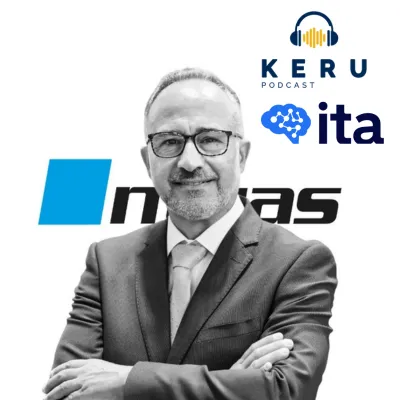
🔍 Article co-created with David Pardo Peiró, CEO at NTGAS Spain (🇪🇸 Spain), and Augusto Unzaga, host of Keru Podcast.
🎙️ This article was inspired by Episode 31 of Keru Podcast.
Keru Podcast, created by Globalita.io, is a series of conversations (in Spanish) with industrial leaders from Latin America about management, technology and decision-making in complex environments.
When quality can’t be seen… but it can be measured
In industries such as food, beverages or Horeca services, machinery plays a silent but crucial operational role. Squeezing, dispensing, heating, dosing… it seems simple, until something fails. For NTGAS Spain, a company that produces smart equipment for the Horeca channel, the real competitive differentiator lies not only in what the machine does, but in how it ensures that it does it well every time.
And this is where the challenge arises: how do you guarantee consistent quality in highly customized mechanical products?
David Pardo Peiró Spain explains it clearly:
“Our customer doesn’t buy a machine: they buy an experience that cannot fail.”
This completely changes the logic of quality control. It is not about detecting errors at the end of the process, but about building a system that prevents, measures and learns. In this context, digitalization in quality control is not a technological add-on: it is the nervous system of the operation.
NTGAS Spain and the new frontier of quality control
From its plant in Valencia, NTGAS Spain has developed a continuous verification model that combines inline sensors, performance monitoring and smart traceability protocols. The goal: detect deviations in real time, without stopping production or waiting for the final inspection.
“If the error is detected at the end, it’s already too late. You need eyes on every critical point of the process.”
This approach translates into full integration between engineering, production and after-sales. Every smart Horeca machine that leaves NTGAS carries a built-in digital record of its behavior, which feeds a continuous improvement system.
This kind of control would not be viable without an adapted digital infrastructure. But it would not work either if the underlying processes were not standardized. That is why digitalization goes hand in hand with technical training, workstation redesign, calibration control and automated validation protocols.
Quality control as an operational advantage: the NTGAS Spain case
While many companies still see quality as a final “filter”, NTGAS Spain decided to turn it into its operational advantage. The reason is simple: in the smart Horeca machinery industry, the margin for error is minimal. If a machine fails in a hotel, restaurant or café, the reputational damage can escalate faster than the technical one.
“In Horeca there are no second chances. If something doesn’t work on first use, there’s no possible loyalty.”
That is why David Pardo Peiró NTGAS structured his quality control system from the very design of the product, integrating principles of lean manufacturing, selective automation and digital traceability.
1. Embedded quality: from inspection to smart design
One of the pillars of the NTGAS Spain David Pardo Peiró model is anticipation. Instead of inspecting what has been produced, the goal is to design so it doesn’t fail. This principle is grounded in the Poka-Yoke philosophy, where errors are eliminated structurally.
Concrete examples:
- Connections that can only fit one way.
- Electronic components with polarity protection.
- Wiring routes coded by color and position.
“If I have to rely on an operator remembering how to assemble something, I’m already failing in the design.”
This approach makes it possible to reduce inspection times and increase assembly reliability, especially when products change by customer, channel or country.
2. Sensors and data: real-time operational traceability
Every unit that leaves the NTGAS Spain plant incorporates sensors that record its behavior from the factory onward. Pressure, flow, temperature, cycles per minute. These data are cross-checked against internal standards and stored by serial number.
This process has three key impacts:
- It allows parameters to be adjusted in real time if there are deviations.
- It reduces the burden of visual and subjective inspection.
- It generates a digital history for technical service or future improvement.
This model is inspired by the Jidoka concept, from the Toyota Production System, where machines detect errors on their own and alert the system. It is not about automating everything, but about automating what protects the quality promise.
“A smart machine isn’t the one that does everything on its own. It’s the one that warns you when something goes wrong.”
3. Lean standards applied to unit lines
Production of Horeca equipment at NTGAS Spain is not mass production. Work is done in small batches, with moderate customization and individual traceability. That is why David Pardo Peiró Spain implemented an adapted version of Lean Manufacturing geared to unit lines.
Key elements of the system:
- Visual standardization with screens showing the status of each order.
- Digital checklists at workstations.
- Peer review between technicians instead of hierarchical supervision.
- Elimination of rework through functional testing before packaging.
This reduces work-in-process inventory, eliminates idle time and improves the onboarding of new operators.
“When you have visual clarity and stable processes, errors become visible before they materialize.”
4. An operating culture focused on quality
One of the frequent mistakes in digitalization processes is thinking that technology replaces people. At NTGAS Spain, the opposite happens: every digital tool is designed to free up operating time and focus people on value-adding tasks.
“Quality isn’t achieved through inspection, it’s achieved through culture.”
To that end, David Pardo Peiró NTGAS promotes three simple practices:
- Cross-training between operators and technical service staff.
- Short daily meetings on the plant floor, with a visible indicator board.
- Voluntary improvement circles, where technicians can propose changes to control processes.
This system is in line with the Kaizen methodology, where improvement is incremental, constant and led from the production floor.
5. Digitalization as a means, not an end
Instead of investing millions in full automation, NTGAS Spain David Pardo Peiró opted for a mixed strategy: digitize what is critical, keep manual what is flexible. This makes it possible to maintain efficiency without losing customization capability.
“You digitize what can be standardized. What changes a lot, you keep human.”
This balance makes it possible to scale without losing agility. The key is to be clear about the boundary between what must be controlled by software and what can be improved with technical judgment. It is a concrete application of the principles of Lean Digital Transformation.
Final reflection
Digitalization in quality control is not a fad, it is a necessity. But implementing it well requires method, judgment and focus. In the case of NTGAS Spain, technology is integrated only after understanding the process, reducing its variability and training the people who operate it.
David Pardo Peiró Spain sums it up like this:
“The best tool can fail if you don’t know what you’re using it for.”
In a sector like Horeca, where every second of use counts and every customer seeks immediate reliability, smart Horeca machinery cannot fail at the basics. And the basics, in this industry, are quality.
🔁 Keru is a podcast created by Globalita.io, where we talk with those who lead Latin American industry from the inside.
Are you digitizing to control, or are you controlling what really matters?
David Pardo Peiró is an industrial entrepreneur with more than 30 years of experience in engineering, manufacturing and product development for the Horeca sector. Since 1999, he has been CEO and founder of NTGAS, a Spanish company specialized in the design and manufacture of professional gas burners and cookers for hotels, restaurants, hospitals and large institutional caterers. Under his leadership, NTGAS has consolidated a line of patented products with European certifications, expanding its presence in domestic and international markets.
View profile and episode →