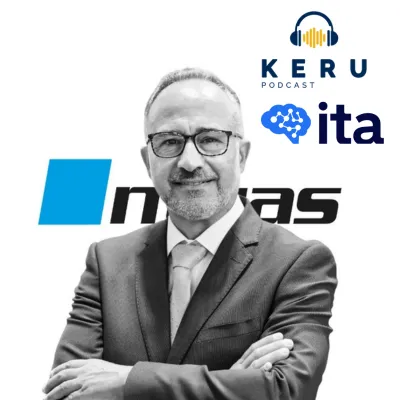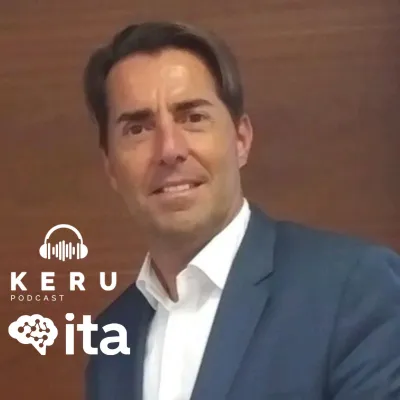

🔍 Article co-created with Juan Manuel Valcárcel Rosado, Engineering and Plant Director at Inventia Kinetics Spain (🇪🇸 Spain), and Augusto Unzaga, host of Keru Podcast.
🎙️ This article was inspired by Episode 31 of Keru Podcast.
Keru Podcast, created by Globalita.io, is a series of conversations (in Spanish) with industrial leaders from Latin America about management, technology and decision-making in complex environments.
When efficiency is not enough
In many industrial companies, especially those with highly specialized technical plants, an absolute focus on operations can create a paradox: being excellent at execution… but without strategic direction.
Inventia Kinetics Spain’s Juan Manuel Valcárcel Rosado sees it clearly:
“There are teams that operate well, but don’t ask themselves what for. They have control, but not vision.”
The phrase illustrates a silent problem: tight processes, error-free production, KPIs met… but a total disconnect from the customer’s objectives or the profitability of the business.
These kinds of companies tend to settle into an operational comfort zone. And when the context changes—new products, price pressure, traceability requirements—the structure doesn’t respond. Why? Because it never trained its strategic muscle.
Juan Manuel Valcárcel Rosado, Spain: efficiency without alignment, a common failure
From his role at Inventia Kinetics, Valcárcel faced this tension while leading industrial processes where three critical dimensions intersect:
- Efficient daily operations.
- Engineering of new developments.
- Strategic adaptation to external requirements.
“You can have a perfect line… and still lose if you don’t understand the impact of each decision on the business.”
Often, the failure is not in the operator, nor in the process. It is in the mental model of technical management: acting as if operations were an end in themselves, not a means to achieve broader goals.
Industrial strategic vision: beyond the control dashboard
The first step Valcárcel’s team took was to review how priorities are defined in the plant. Looking at OEE or unit costs was no longer enough. Every decision had to be aligned with a logic of profitability and service to the end customer.
This change involved:
- Redefining the role of middle leaders.
- Translating business objectives into operational variables.
- Questioning projects that, although “well executed,” did not add value.
Aligning operations and strategy: how to move from executing well to deciding better
Many industrial organizations manage to maintain excellent operational performance: on-time deliveries, well-balanced lines, low staff turnover. But as Juan Manuel Valcárcel Rosado, Spain, warns, that does not guarantee they are making good business decisions.
“You can be very good at operating… and still be losing money.”
That gap occurs when teams prioritize execution without understanding its strategic context. The result: efficiency in the wrong things, automation without purpose and continuous improvements that don’t impact the bottom line.
1. Diagnosis: when does an operation stop being profitable?
At Inventia Kinetics Spain, with Juan Manuel Valcárcel Rosado, the first step was recognizing that not every efficient operation is profitable. For this, tools such as the following were used:
- SIPOC map (Suppliers, Inputs, Process, Outputs, Customers): to visualize the complete flow and detect where value is lost.
- Profitability analysis by SKU: which revealed that some operationally star products were a financial loss.
- Strategic impact matrix: which crossed volume with real profitability to prioritize engineering and production attention.
“The hardest part was accepting that there were very well-made products… that had to be discontinued.”
2. Operational alignment with profitability: a daily practice
Based on the diagnosis, a new prioritization logic was established. Efficiency was still important, but it was not enough. Every operational decision had to pass through three filters:
- Does it add real value for the customer?
- Does it improve profitability or does it only optimize the process?
- Is it aligned with the long-term strategy?
Practices such as these were incorporated:
- Weekly prioritization meetings between operations, engineering and sales.
- Profitability visuals on the plant floor (protected, but available to cell leaders).
- Cross-training so that technicians understand the economic impact of each variation.
3. Integrating the customer into industrial decision-making
One of the most significant changes in the model was to stop designing operational solutions with their backs to the customer. As Valcárcel points out:
“An industrial plant can’t be a bubble. What we do only makes sense if the customer values it.”
This led to:
- Including commercial feedback in production scheduling.
- Evaluating not only technical compliance, but the real level of satisfaction.
- Adjusting the continuous improvement logic to take customer drivers into account (delivery time, flexibility, quality stability).
4. Decision-making in complex industrial environments: simplifying without losing depth
To face environments where the product portfolio changes constantly, as at Inventia Kinetics with Juan Manuel Valcárcel Rosado, a decision-making system was needed that did not depend exclusively on management.
The solution: decision protocols by level, supported by:
- Risk vs. impact matrix
- Weekly PDCA (Plan–Do–Check–Act) cycle in each team
- Defined criteria for problem escalation
- Structured spaces for reflection: what was decided, why and with what impact
“It’s not about everyone deciding everything, but about each person knowing what they can decide, with what criteria and for what result.”
5. From the dashboard to the business: how to turn indicators into strategic decisions
One of the key lessons was that operational indicators—such as OEE, scrap or downtime—can be misleading if they are not connected to strategic indicators such as margin per product, return on maintenance investment or customer-perceived value.
That is why Inventia Kinetics Spain redesigned its indicator structure:
- Every technical KPI now has a strategic mirror indicator.
- They are cross-checked weekly in integrated dashboards, visible to middle managers.
- The plant meeting includes a fixed slot for “decisions with impact,” not just for reviewing numbers.
This practice is based on the principle of the Balanced Scorecard, applied at the operational level: connecting technical metrics with business results.
6. What can an industrial manager apply starting today?
These are concrete steps any manager can implement tomorrow:
🔹 SIPOC map by line or product family
Visualize which inputs affect the final result and where value is lost.
🔹 Identify products that are efficient but not profitable
Analyze real profitability by SKU, not just technical performance.
🔹 Add the voice of the customer to production routines
Do your decisions reflect their priorities?
🔹 Cross your technical KPIs with financial indicators
Ask: Does this good number… generate business or just a good impression?
🔹 Train the team to think with strategic judgment
Not everyone has to decide, but everyone must understand the impact of what they do.
Final reflection
Operational excellence is necessary. But it is not enough. If decisions are not aligned with strategic objectives, efficiency can be a trap.
Juan Manuel Valcárcel Rosado, Spain, drawing on his experience at Inventia Kinetics Spain, reminds us that operations cannot live disconnected from the business. It is not just about doing things right. It is about doing the right things, at the right time, for the right reasons.
“Being excellent at the wrong thing is the worst form of inefficiency.”
And you, as a manager:
Does your team operate well… or decide well?
🔁 Keru is a podcast created by Globalita.io, where we talk with those who lead Latin American industry from the inside.