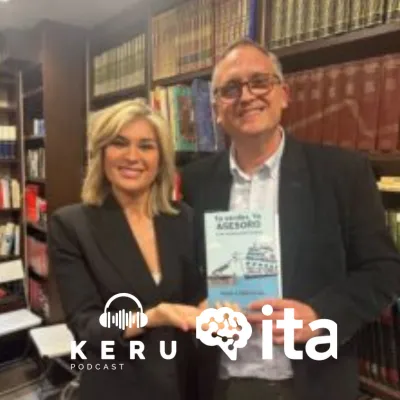
🔍 This article was co-created with Miguel Ángel Rubio Wegmann Spain, a sales director with more than 20 years of experience in industrial sales management and a specialist in international consultative selling, author of the book Tú vendes, yo asesoro.
🎙️ Keru Podcast is a product of Globalita, featuring a series of conversations (in Spanish) with industrial leaders from Latin America about management, technology and decision-making in complex environments.
Problem / challenge: International consultative selling in saturated markets
In a scenario where industrial products have become commoditized and buyers are hyperconnected, the traditional technical B2B sales process has lost effectiveness. For Miguel Ángel Rubio Wegmann Spain, the only competitive advantage is to position oneself as a strategic technical salesperson, capable of becoming a decision advisor, not just a transaction manager.
“The customer no longer needs you to explain the catalog. They need you to help them decide with information they don’t have.”
The challenge is not to sell more, but to manage long-term industrial relationships, where the sales cycle is defined by trust, technical evidence and operational sensitivity. In this context, international consultative selling emerges as an operational and strategic necessity.
Decisions are no longer made on price alone. Variables such as local regulations, after-sales availability, technical application risks and operational sustainability come into play. And in that context, the strategic technical salesperson must lead a process where data, empathy and credibility weigh more than commercial offers.
Reflections on the new role of the strategic technical salesperson
Miguel Ángel Rubio Wegmann Spain questions the traditional logic of the salesperson who recites data sheets and pushes discounts. That figure is a thing of the past. In its place, he proposes the profile of a decision facilitator who helps the customer evaluate solutions, risks and returns on technical investment.
This vision is linked to Neil Rackham’s SPIN Selling model, where the focus shifts from product features to the implications of not solving a problem. But Miguel Ángel goes further: he incorporates systems thinking, organizational learning and sales knowledge management as pillars of modern industrial sales management.
“A consultative salesperson doesn’t force a sale. They build a relationship that sustains several decisions over time.”
This logic requires the strategic technical salesperson to deeply understand the customer’s production environment: its processes, its key indicators, its critical operating points. It is not about selling adhesives; it is about understanding the product’s life cycle on the production line.
Applications at Wegmann: How to build an international consultative selling model
a) Comprehensive technical training for the sales team
Methodology applied: Learning by Doing + Functional specialization
At Wegmann, everything starts with technical training. For Miguel Ángel Rubio Wegmann Spain, international consultative selling cannot be sustained if the advisor does not master the context in which their product will be used.
Salespeople must have in-depth knowledge of:
- The customer’s manufacturing processes
- The materials and their technical conditions
- The limitations of real-world use and the hidden risks
- The life cycle of the applied product
The goal is not to turn the salesperson into an engineer, but into a valid counterpart for the customer’s technical area. This knowledge feeds credibility, enables value conversations and reduces technical objections before they arise.
“You can’t sell a technical adhesive if you don’t understand how the line where it will be applied works.”
This view of the technical B2B sales process turns every meeting into an opportunity for two-way learning, where the advisor listens, documents, tests hypotheses and validates with evidence.
b) Advanced customer segmentation by decision-making profile
Methodology applied: Customer Decision Journey + SPIN Selling
In industrial sales management, one of the most frequent mistakes is treating the customer as a homogeneous unit. Miguel Ángel Rubio Wegmann Spain insists on segmenting not only by sector, but by role within the purchasing process.
“The one who decides is not always the one who signs. And the one who signs is not always the one who will suffer if something fails.”
Wegmann’s sales team classifies its counterparts according to:
- Their technical function (production, maintenance, quality)
- Their decision-making power (executive, technical, operational)
- Their primary motivations (cost, safety, ease of application, maintenance)
With this segmentation, the technical B2B sales process adapts. The most relevant information for each counterpart is prioritized, objections are anticipated and a more agile and predictable decision path is designed.
This approach raises the success rate and reduces dependence on a single contact, building more resilient commercial relationships.
c) Progressive application of international consultative selling in Latin America - Miguel Ángel Rubio Wegmann Spain
Drawing on his experience, he has driven advanced technical sales processes in Spain, Portugal and several Latin American markets. In all of them, the consultative logic works, but it requires cultural and organizational adaptations.
For example:
- In Latin America, the human bond is prioritized. Consultative selling must start from relational trust before the technical argument.
- In Europe, data is valued. There, the sale must show case studies, benchmarking and documentation.
This contextual understanding is part of the continuous learning of every strategic technical salesperson and feeds the building of a sales culture centered on the real customer, not on an ideal archetype.
Digitalization of the sales process in international consultative selling
One of the most relevant transformations driven by Miguel Ángel Rubio Wegmann Spain at Wegmann was the digitalization of the sales process, but with a clear focus: generating value traceability. Instead of merely recording sales interactions, the new system makes it possible to understand why something was sold, what was proposed, what was solved and how that result is measured.
“Digitalizing is not filling a CRM with activities. It is building sales memory that is useful for everyone.”
This model, based on the Value Mapping approach from Harvard Business Review (2006), connects each proposal with the following key elements:
- Technical problem identified at the plant
- Justification of the chosen solution
- Expected results and after-sales follow-up
- Attached documentation: tests, data sheets, references
In international consultative selling, this traceability becomes a strategic advantage. It makes it possible to scale knowledge among salespeople, detect purchasing patterns by region and anticipate objections based on real experiences.
It also generates reusable commercial assets: case studies, solution matrices, technical-financial ROI models. The technical B2B sales process thus becomes a platform for continuous organizational learning.
Industrial sales management indicators: beyond the close
Another key contribution by Miguel Ángel Rubio Wegmann Spain was redesigning the sales indicators at Wegmann. For him, evaluating by number of closed deals is obsolete. What matters is the value created, the trust built and the ability to sustain a long-term relationship.
“A good salesperson is not the one who sells the most. It’s the one who makes the customer come back with confidence and with more problems to solve.”
The defined KPIs are integrated into a Commercial Balanced Scorecard with indicators such as:
- Average length of the consultative cycle
- Repurchase rate with the same counterpart
- Technical-operational NPS after implementation
- Level of documentation delivered vs. requested
These data allow sales management to identify not only who closes the most, but who develops deeper relationships, who builds technical credibility and who best understands the customer’s business.
In the context of industrial sales management, where decisions are not immediate and cycles are long, this type of indicator makes it possible to reward quality over speed.
Purpose-driven sales culture: the DNA of the strategic technical salesperson
For Miguel Ángel Rubio Wegmann Spain, no technique works without purpose. That is why he promotes a culture where selling is not an end in itself, but a consequence of understanding, supporting and solving.
At Wegmann, the sales culture is structured around five principles:
- Technical curiosity: the salesperson must ask, research and learn every day.
- Operational listening: you don’t sell from the offer, but from a real understanding of the problem.
- Cross-functional feedback: sales meetings include technical, quality, logistics and after-sales areas.
- Tolerance for error: documenting mistakes to turn them into improvement, not punishment.
- Shared language: the solution must be explainable to all of the customer’s stakeholders.
“When selling becomes pressure, it gets contaminated. When it is a consequence of doing things well, it becomes sustainable.”
This approach turns each salesperson into a strategic technical salesperson, capable of navigating complex environments with technical tools, business vision and human skills.
Success stories and expansion in international consultative selling
Thanks to this model, Wegmann managed to strengthen its presence in highly technical markets such as Germany, Mexico, France and Chile. In each of them, international consultative selling adapted its resources:
- In Mexico: tests under local conditions were added to demonstrate thermal resistance.
- In Germany: technical documentation and traceability of results were reinforced.
- In Latin America: operational after-sales support and on-site validation at the plant were prioritized.
Miguel Ángel Rubio Wegmann Spain believes that these cases are not the exception, but a sample of what happens when the salesperson stops being a tactical operator and becomes an architect of solutions.
In addition, these learnings are integrated into the training of new salespeople: each new hire receives a folder with case studies, decision-making patterns by industry and recommendations by type of customer.
Final reflection: Can international consultative selling develop leaders?
Beyond the commercial results, Miguel Ángel Rubio Wegmann Spain maintains that consultative selling can be a school of leadership. The reason is clear: whoever learns to listen, diagnose, support technical processes and manage trust develops key skills for any management role.
“A good consultative salesperson has everything it takes to be a great manager. All they need is to understand that they don’t sell products, but decision processes.”
The technical B2B sales process is today one of the most challenging frontiers in industry: it requires vision, data, human skills and technical mastery. But it also offers one of the greatest opportunities for impact: helping customers operate better, decide with more confidence and build relationships where everyone wins.
In a globalized market, where geographic barriers disappear but problems become more complex, the strategic technical salesperson is much more than a salesperson. They are a solutions integrator, a technical ambassador and an ally in the customer’s operation.
🎙️ Keru Podcast is a product of Globalita, featuring a series of conversations (in Spanish) with industrial leaders from Latin America about management, technology and decision-making in complex environments.
Are you preparing your sales team to build technical trust in a market where what is sold is the support, not the product?
Miguel Ángel Rubio Arnáiz is a benchmark in humanized sales leadership and consultative selling, with more than 20 years of experience in sales management and team leadership. He was General Manager at WEGMANN automotive Iberia, leading the strategic and commercial operation in Spain and Portugal for one of the leading global companies in automotive balancing systems. At WEGMANN, he drove the cultural transformation of the sales team, integrating indicators with a human vision: “behind every number there is a decision.” He is also the author of the book “Tú vendes, yo asesoro” (You sell, I advise) and a creator of professional content through El Valor de la Venta, a project with which he amplified his training impact among leaders and salespeople.
View profile and episode →