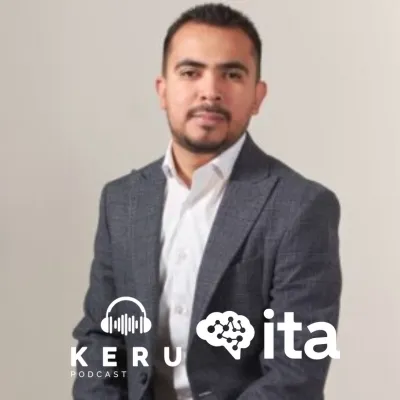

🔍 Article co-created with Juan Carlos Guzmán Sedano, General Director at Grupo Comercial de Empaques México (🇲🇽 Mexico), and Augusto Unzaga, host of Keru Podcast.
🎙️ This article was inspired by Episode 31 of Keru Podcast.
Keru Podcast, created by Globalita.io, is a series of conversations (in Spanish) with industrial leaders from Latin America about management, technology and decision-making in complex environments.
When the input is the problem (and nobody wants to see it)
In many industries, inputs are taken for granted as “commodities.” Paper, cardboard or plastic are simply expected to work, without looking much beyond the price. But in the corrugated packaging sector, that logic can be very costly. At Grupo Comercial de Empaques México, experience showed that variability in the quality of corrugated paper has a direct impact on scrap, efficiency and final delivery to the customer.
“Not every paper works for our lines. If you don’t detect it in time, you’ve lost three shifts and you don’t know why.”
That is how Juan Carlos Guzmán Sedano Mexico explains it. He leads an operation that deals every day with different suppliers, multiple formats and specific technical requirements for each customer. What looks like a standard reel can end up causing:
- jams in the forming machine,
- gluing problems,
- poor structural strength,
- or even customer rejections due to deformation of the final product.
Grupo Comercial de Empaques México and the paradox of “good” paper
In this context, Grupo Comercial de Empaques Juan Carlos Guzmán Sedano understood that the problem was not only technical: it was systemic. The failures were not in the operation… but in the input. But since there was no standardized measurement or clear traceability of the material, the errors were attributed to production, maintenance or even the operator.
“At first we argued with production. Then we saw that the problem came from the raw material.”
This change of focus was key. It exposed a gap: there was no structured system to evaluate the input in real time. Only when they began to apply internal tests of grammage, moisture, stiffness and thermal behavior were they able to anticipate deviations before they turned into hidden costs.
Controlling cardboard as if it were a strategic asset
At Grupo Comercial de Empaques México, led by Juan Carlos Guzmán Sedano Mexico, the quality of the final product does not depend only on the machine or the operator. It depends, to a large extent, on a material that many underestimate: corrugated cardboard. When that input does not meet the right standards, scrap, unplanned stoppages and customer rejections shoot up.
The problem is not that the cardboard “doesn’t work,” but that its behavior can vary enormously depending on its origin, composition and storage conditions. Faced with this challenge, Grupo Comercial de Empaques Juan Carlos Guzmán Sedano chose to do something unusual: treat the input as a potential source of operational risk.
“We had to stop thinking that cardboard is generic. If you don’t measure it, it’s going to fail you.”
1. Detect before processing: the input “poka-yoke”
One of the first measures implemented was the creation of a receiving protocol that works as an incoming Poka-Yoke. Each batch of cardboard goes through a battery of tests before being released to production. The following are measured:
- grammage,
- moisture level,
- burst strength,
- and behavior when folded hot.
Only if it meets predefined parameters —established jointly by quality, production and maintenance— does the batch go onto the line. Otherwise, it is isolated.
This logic is not meant to punish the supplier, but to protect the stability of the process. It works as a first line of defense against operational failures caused by input variability.
2. FMEA applied to the input: anticipating failure modes
To achieve greater anticipation, a raw material FMEA was applied. Instead of using this methodology only for processes or new developments, it was used to map all the ways in which the input can fail.
This made it possible to identify failure modes such as:
- paper that cracks in the gluer due to inadequate moisture,
- poor flute adhesion due to insufficient coating,
- structural collapse during stacking due to a poor combination of liners.
Each of these failure modes was linked to a corrective action, in receiving as well as in storage and use.
“Cardboard can’t be a black box. You have to know what to expect from it.”
3. Supplier classification and cross traceability
Grupo Comercial de Empaques México established a system for classifying suppliers according to technical history, rejection rate and consistency in physical parameters. It is not only about price, but about reliability.
Batches that show frequent deviations are reported, documented and can be blocked from critical production. In addition, cross traceability by batch was implemented: every reel that comes in is linked to the order, line and shift in which it was used.
This makes it possible to:
- Identify the origin of any problem faster,
- Avoid repeating mistakes in future orders,
- Demand specific corrective actions from suppliers.
4. Technical training and a culture of control
One of the biggest challenges was cultural. The plant team was not used to evaluating cardboard as a critical factor. That is why Juan Carlos Guzmán Sedano Mexico promoted an internal campaign with specific training for operators, supervisors and quality staff.
“It’s one thing for the operator to detect that something is wrong. It’s quite another for them to be able to explain why.”
The following were developed:
- visual failure manuals by type of paper,
- reaction protocols for anomalies,
- and visible input indicator boards.
This consolidated an operating culture in which cardboard stopped being an assumption and became just another technical parameter.
5. Digitalization without excess: a focus on operational visibility
Although no money was invested in costly automation, simple digital tools were introduced that make it possible to record each batch and its behavior on the plant floor. Through forms on tablets and digital check sheets, operators enter data in real time.
This data feeds dashboards that cross-reference:
- Cardboard batch,
- Line,
- Operator,
- Product type,
- Recorded incidents.
This approach makes it possible to correlate variables, detect trends and generate preventive alerts. It is an accessible way of applying the principles of Visual Manufacturing and Digital Lean, without depending on large investments.
Lessons for other industries
The case of Grupo Comercial de Empaques México is a clear example of how quality problems do not always originate in production, and how poorly controlled inputs can create hidden operational failures.
Any company that works with sensitive materials —paper, cardboard, film, technical plastics, textiles, etc.— can apply these principles:
- Treat the input as a potential source of operational risk.
- Use FMEA and Poka-Yoke to prevent rather than correct.
- Trace by batch, not only by final product.
- Train the team to understand what it receives, not only what it manufactures.
- Measure suppliers by technical performance, not only by cost.
Final reflection
In high-volume industries with tight margins, what looks like a small deviation can have a big impact. Controlling cardboard is not micromanagement: it is smart management. And as Grupo Comercial de Empaques Juan Carlos Guzmán Sedano learned, the difference between profit and loss often lies in how you control what nobody is looking at.
“You can have the best machine, the best team… but if the cardboard doesn’t work, everything else falls apart.”
🔁 Keru is a podcast created by Globalita.io, where we talk with those who lead Latin American industry from the inside.
Is your star input really under control?
Juan Carlos Guzmán Sedano is a Mexican industrial engineer with more than 10 years of experience in the packaging industry, leading operations, sales and general management at companies such as Grupo Comercial de Empaques, PCM and Papelcor. A specialist in corrugated cardboard, polyurethane and wood solutions, he combines technical knowledge with a commercial focus. He has managed multidisciplinary teams, implemented ERP/MRP systems and optimized supply chains. His experience also includes financial management, plant management and quality assurance at firms such as Ureblock and Continental. He is currently pursuing a Master's in Finance and leads projects from Zapopan, Jalisco.
View profile and episode →