

🔗 This article was inspired by the interview with Felipe Kopelowicz on Keru Podcast.
View the interviewee’s profile →
manufacturing software, MES system for manufacturing SMEs, industrial automation, industrial software development, production traceability software are more than keywords: they are pillars of a new era of industrial operational leadership in Latin America.
The current manufacturing environment in Latin America calls for a deep transformation. Technology is no longer optional; it is a condition for survival. But technology on its own does not create impact. It needs to serve a clear industrial logic and adaptive decision-making. That is what this article is about.
The problem from the plant floor: blind decisions in changing environments
In Latin American factories, the industrial manager faces a messy board: last-minute rush orders, parts that don’t arrive, buffers out of control, machines without preventive maintenance and teams that work on intuition rather than data.
Manufacturing SMEs are especially vulnerable to this chaos. With fragile operating structures and multitasking staff, any disruption in the chain creates cascading effects. Added to this is an increasingly common demand from management: making decisions “in real time” without having the necessary data or the infrastructure to obtain it.
From a plant engineering perspective, this situation exposes a structural blind spot: the lack of an MES system for manufacturing SMEs. This type of software makes it possible to coordinate critical areas —production, inventory, purchasing and logistics— through a single synchronized platform.
In its absence, orders are processed on paper or in Excel, cycle times are not measured accurately, and problems are only detected once they have already caused losses.
Having manufacturing software is not synonymous with sophistication: it is the first step to stabilizing the factory’s operating system. And the sooner it is adopted, the better the chances of doing so at low cost, with high team involvement and less cultural resistance.
Operational dashboards with PDCA logic
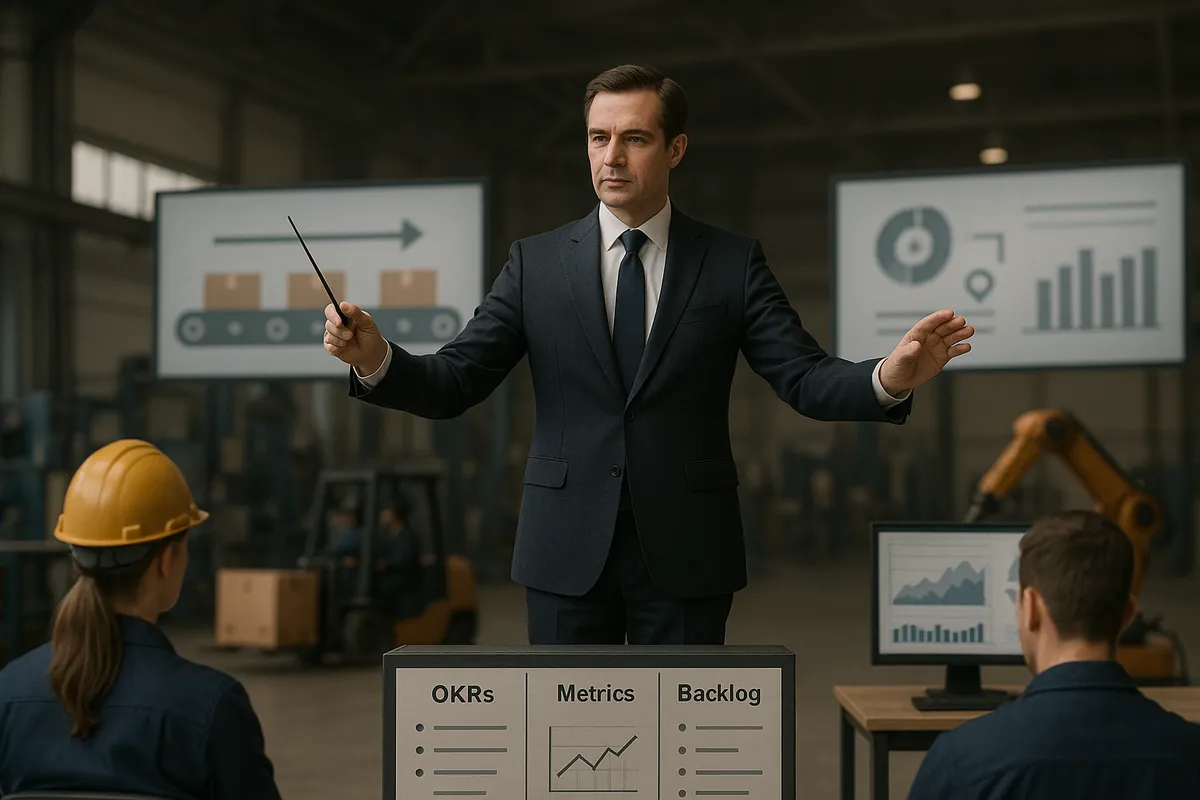
Once data capture is stabilized, the next step is to translate it into decisions. The Tech CEO understands that dashboards are not decorative panels: they are active control boards that must inform and trigger action.
To do this, many leaders turn to the PDCA (Plan-Do-Check-Act) model, developed by William Deming. This methodology makes it possible to improve processes continuously through short, controlled iterations. In the industrial context, this framework translates into:
- Plan: define clear goals per shift or line (for example: expected OEE of 85%).
- Do: execute by integrating data from sensors, ERP and the MES system.
- Check: analyze deviations in real time from dashboards with operational KPIs.
- Act: trigger automatic alerts, activate adjustment protocols or coordinate corrective actions.
This is only possible if the factory has industrial software development that connects with real data from the floor. A system that comes down from the IT tower without ever having set foot in the plant is of no use. It must be designed from the real flow, with a focus on operators, supervisors and those who make decisions under pressure.
Many systems fail because they are not made for the people who use them. Overloaded interfaces, rigid flows and lack of context lead staff to reject the tool and go back to Excel or paper. That’s why good manufacturing software must balance technical robustness with usability.
Dynamic buffers with AI: from TOC to the adaptive algorithm
Buffer management is one of the nerve centers of any plant. A poorly sized buffer can create waste or stoppages. This is where the Theory of Constraints (TOC), proposed by Eliyahu Goldratt, comes into play: it proposes protecting bottlenecks with strategic buffers.
The problem is that, in environments like Latin America —where demand is erratic, logistics uncertain and suppliers unreliable—, fixed buffers quickly become obsolete. A plan that works today collapses tomorrow.
This is where the opportunity arises to combine TOC with industrial automation and artificial intelligence. Through machine learning algorithms, the system can:
- Adjust buffers dynamically according to turnover, reliability and changes in demand.
- Reconfigure production routes in real time.
- Simulate contingency scenarios to anticipate bottlenecks.
This gives rise to an adaptive system, where the buffer is no longer static, but intelligent. The plant manager doesn’t need to intervene manually every time: they have an algorithmic copilot that suggests actions according to the operational reality.
But like any powerful tool, its adoption comes with challenges. The main one: breaking with the logic of “this is how it’s always been done.” This transition is not achieved with software, but with leadership.
📲 Follow us on LinkedIn: Globalita and Keru Podcast
Production traceability software: beyond the barcode
In many manufacturing SMEs, traceability is associated only with the use of barcodes. However, this is just a minimal expression of the real potential.
True production traceability software makes it possible to follow each part from the receipt of raw material to final delivery. It connects work orders, machines, people, materials and operating conditions.
By integrating this solution with the MES system for manufacturing SMEs, you can:
- Reconstruct the complete history of any batch.
- Audit processes for certifications or complaints.
- Detect patterns of scrap or defects by shift, equipment or line.
- Adjust prices based on evidence of quality and efficiency.
Beyond its operational value, traceability becomes a strategic asset. Companies that can demonstrate full control of the process have more negotiating power, lower legal risks, and a better reputation with industrial customers.
Where does implementation fail? In the lack of cultural preparation. If operators don’t understand what the data is for, they skip it. If supervisors don’t use the reports, the system becomes a forgotten repository. The key lies in aligning culture and technology.
The CEO as Orchestrator of Adaptive Systems (OSA)
We propose a new concept of industrial leadership: the OSA CEO – Orchestrator of Adaptive Systems.
The OSA CEO is the leader who does not seek to control everything, but to design a plant system that self-regulates, adapts, and learns continuously in volatile environments.
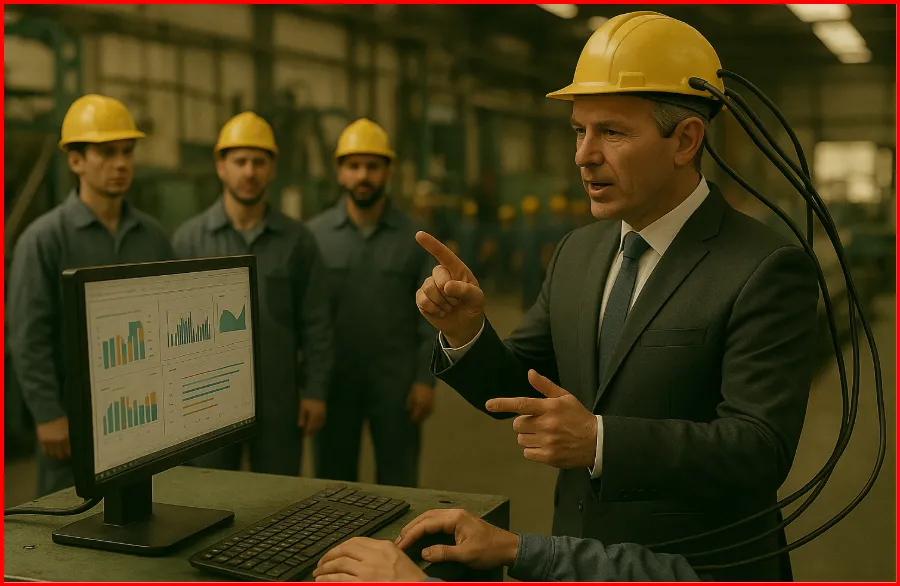
This type of CEO doesn’t impose tools: they design architectures. They integrate manufacturing software, IoT sensors, prediction algorithms, real-time dashboards and purposeful operating routines. It’s not about adding platforms, but about creating a coherent system.
Their job is to maintain the operational flow. Detect emerging bottlenecks. Create the conditions for teams to make decisions with data. Promote constant learning in short cycles. Be more architect than executor.
This profile requires understanding buffers, information loops and improvement cycles more than financial control. It is the kind of leadership that can thrive in Latin American factories, where adaptability is more valuable than rigid planning.
Final reflection: industrial logic before tools
Manufacturing software is not magic. It doesn’t transform a plant on its own. But when it is implemented from a clear industrial logic, it can multiply the impact of decisions.
The Tech CEO must master the operational basics: cycle time, root causes, throughput, OEE, buffers, critical indicators. Without this, any technology becomes an “expensive toy.”
The competitive advantage in manufacturing is not in having more technology, but in making better use of the available technology. That means developing operational leaders with a systemic vision, designing adaptive flows and building cultures of continuous improvement.
🧠 Is your plant ready to operate with manufacturing software?
A brief self-assessment:
- Are your reports 48 hours behind?
- Do you know your real cycle time per order?
- Do you detect scrap per shift or only when the customer complains?
- Does your team see operational dashboards or only month-end reports?
- Is the backlog measured on spreadsheets or in real time?
If you answered “yes” to more than two questions, then there is room to redesign your decision-making system with the support of data.
🔗 Suggested internal link: Also read our article on industrial automation in SMEs to understand how to start from the basics.
📲 Follow us on LinkedIn: Globalita and Keru Podcast