

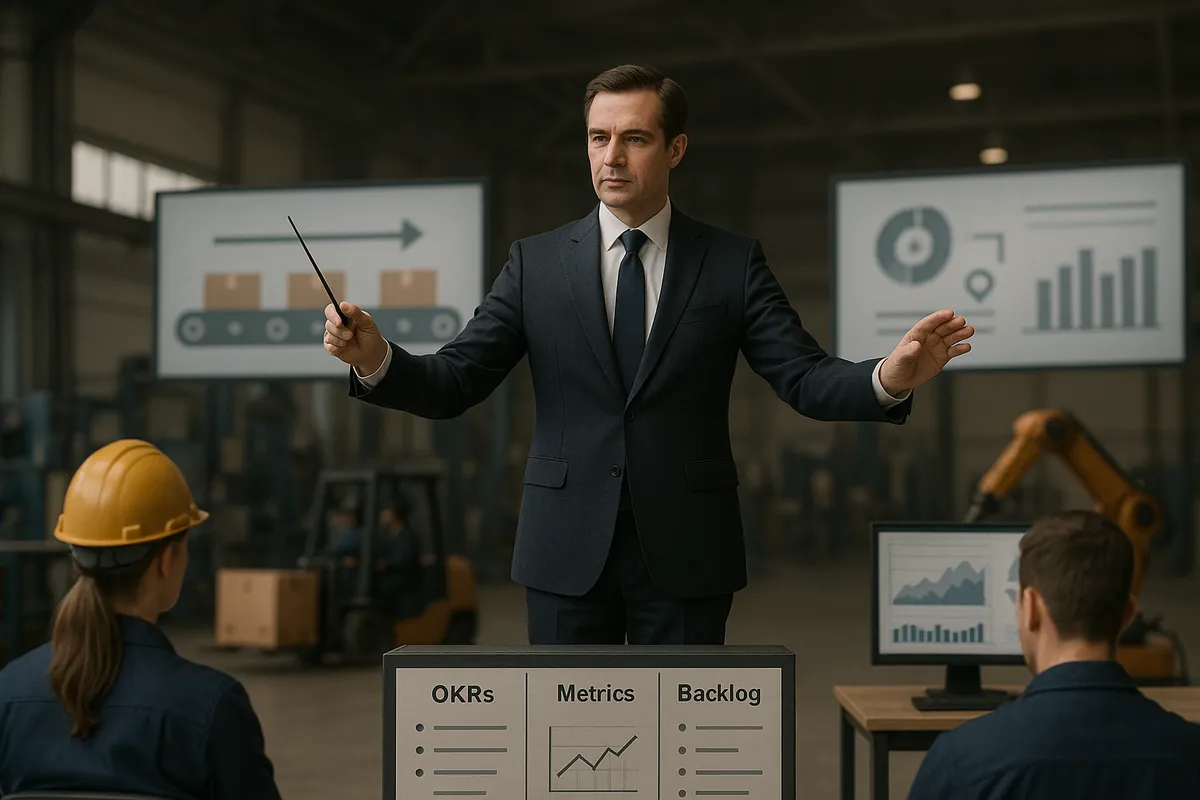
From startups to traditional industries, we analyze how adaptive leaders rely on agile tools and dynamic metrics to respond to changing contexts.
Crises are no longer exceptional interruptions. They are a structural part of the operating environment. In sectors such as manufacturing, retail, technical services or the textile industry —where technological and market change cycles overlap—, leadership can no longer be based on total control or rigid planning. It needs to be based on measurable and orchestrated adaptability.
Leading with agility does not mean improvising. It means integrating technology, people and structures that make it possible to change course without losing operational traction. This competency becomes critical when the system is exposed to multiple simultaneous pressures: customer pressure, team saturation, supplier failures, political uncertainty or new digital channels.
In this new scenario, agility is not speed: it is informed responsiveness.
Adaptability as a system, not as individual talent
For years, companies depended on “strong leaders” who would absorb the blow in times of crisis. Today, that no longer scales. The organizations that thrive are those that design adaptive structures, where leadership does not lie in individual heroics, but in the ability to trigger signals, make data-based decisions and modify the operation without trauma.
In that context, successful leaders —both in startups and in traditional industries— do not hand out tasks: they orchestrate feedback loops, validated learning and distributed execution.
This model requires integrating:
- Agile tools for leaders, such as sprint tracking boards, structured review meetings, adaptive OKRs or prioritized decision dashboards.
- Shared visibility, where everyone sees the same thing in real time (progress, alerts, backlog, responsibilities).
- Dynamic management metrics, which adjust to the operating cycle or the critical context (they do not stay fixed if the environment changes).
“The manager’s role is not to make every decision, but to create the conditions for the right decisions to emerge at the right time,” any modern leader who has survived more than one internal technological transformation would say.
From rigid companies to learning organizations
An adaptive organization is not one that never fails. It is one that can quickly recognize when it is failing, learn in layers and adjust with a low transition cost. That cannot be achieved without structure. Much less without data.
That is why leadership in tech environments is built on three key layers:
- Modular strategy, which can be redefined without breaking everything.
- Flexible technology, which does not make the flow rigid but enables it.
- A review culture, where change is not a threat but a routine.
📲 Follow us on LinkedIn: Globalita and Keru Podcast
Leading with agility: building advantage in contexts of permanent change
Leading with agility is not a personality trait, but an organizational capability that is designed, trained and measured. In companies operating in environments of technological transformation —textile, automotive, pharmaceutical or food industries—, agility is not an aspiration. It is an operating system.
Adaptive leaders no longer make decisions from behind a desk, but through feedback cycles, continuous validation and systemic reconfiguration.
From talent to system: how adaptability is operationalized
Adaptability as a management competency requires three conditions to work:
- Flexible structure: the organization must allow changes of course without major friction.
- Actionable data: information must be available in real time, filtered and contextualized.
- Iterative processes: errors must be detected and processed quickly, not escalate out of control.
This means replacing the “predict and control” logic with “experiment, measure and adjust”. And that change relies on agile tools, not as fads, but as practices integrated into the operation.
Agile tools for leaders: a toolbox for responding, not reacting
Adaptive leaders use tools for three purposes:
- Immediate visibility of the system: what is happening right now?
- Decision prioritization: what should I do first?
- Structured learning: what worked, what didn’t, and why?
Among the most common:
- Adaptive OKRs: they replace the rigid annual plan with reviewable quarterly objectives, connecting business goals with team initiatives.
- Structured biweekly reviews: alignment sessions where deviations are analyzed and actions are prioritized according to operational impact, not political agenda.
- Dynamic management metrics: indicators that change with the context, such as “rate of reversible decisions” or “average correction cycle”.
- Executive Kanban boards: they do not show tasks, but decisions in progress, pending decisions and their accountable owners.
These tools do not work in a vacuum. They need an environment that tolerates learning. And for that, error must stop being a symbol of weakness and become an input for redesign.
Real cases: how traditional industries apply agility
Mid-sized industrial companies in Latin America are starting to apply agility beyond the IT area. Here are some real (anonymized) examples:
- A medical textile company redesigned its management committee as a “weekly cycle of adaptive decisions”, with operational backlog metrics and implemented learnings.
- A food company replaced its monthly meetings with daily execution boards shared with plant, sales and logistics leaders.
- A regional chemical company incorporated OKR boards to measure not only goal achievement, but useful deviations, rewarding learning over perfectionism.
What is interesting about these cases is not the tool used, but the logic adopted: agility as a framework for conversation, not as a management format.
Dynamic management metrics: measuring what changes
In an adaptive system, fixed metrics lose meaning. What matters is responsiveness. That is why new indicators are emerging:
- Organizational learning speed: average days between an alert and an effective corrective action.
- Team autonomy level: percentage of decisions resolved without hierarchical escalation.
- Active strategic redesign level: how often priorities are adjusted in response to changes in context.
- Operational saturation index: a measure of how many teams are operating at the limit of their cognitive capacity.
These metrics do not replace traditional KPIs (sales, EBITDA, OEE), but they make it possible to tell whether the company is alive in its nervous system, not just on its balance sheet.
Which methodologies support this approach?
Several conceptual frameworks can be integrated into the logic of leading with agility:
📌 Lean Startup
Developed by Eric Ries. It proposes fast build-measure-learn cycles. In industry, this translates into process prototyping, testing operational hypotheses and continuous redesign.
📌 OKRs (Objectives and Key Results)
Created by Andy Grove (Intel) and popularized by Google. Its power lies in connecting strategy and execution, leaving room for periodic review and adaptive focus.
📌 Agile Management
More than a methodology, it is a management culture. Short iterations, multidisciplinary teams, continuous feedback and a clear purpose.
📌 Management 3.0
Proposed by Jurgen Appelo. It emphasizes distributed leadership, empowerment with accountability and healthy feedback structures.
All these frameworks can be adapted to industrial organizations if they are translated into operational language and not imposed as a fad.
Final reflection: are you leading a company with memory or with adaptability?
A successful company in the 90s could win on experience. Today, the winner is whoever knows what to let go of, what to adjust and what to test. Experience is useful… as long as it doesn’t become a trap.
Adaptability is the new structural capital. And agility, the way to manage it.
A modern leader does not need to have all the answers. They need to design a system that generates better questions, validates quickly and scales what works.