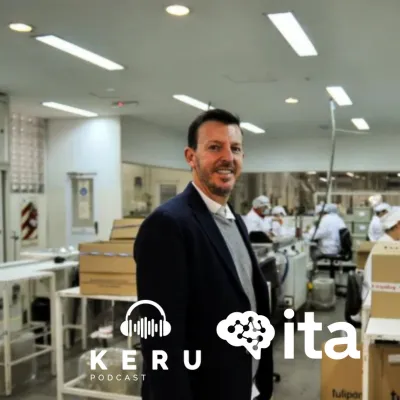
🔍 This article was co-created with Felipe Kopelowicz, CEO at KOPELCO Argentina (🇦🇷 Argentina).
🎙️ This article was inspired by Episode 01 of Keru Podcast
Keru Podcast is a podcast created by Globalita.io, where we talk with those who lead Latin American industry from the inside.
Problem / challenge: Managing under structural uncertainty in the Argentine manufacturing industry
In highly complex Latin American industrial environments, the figure of the general manager mutates: it stops being a strategic designer and becomes a systemic operator. In this conversation with Felipe Kopelowicz Kopelco Argentina, CEO of KOPELCO Argentina, we dig into how to lead an industrial company in an economy like Argentina’s, where planning six months ahead has become unfeasible.
“Today it’s not about planning six months ahead, but about redrawing the map every week without losing the business baseline.”
The textile manufacturing industry faces price volatility, double-digit monthly inflation, indexed labor costs and intermittent demand. This entropy makes traditional management systems obsolete and pushes managers to operate in a constant adaptive mode.
In the case of KOPELCO Argentina, which operates in the textile and laboratory sectors (condoms, technical supplies and pharmaceutical products), non-linear planning becomes an organizational muscle rather than a technical tool. Industrial management in crisis becomes the ground where flexibility and discipline must coexist.
Reflections on that problem: Between the rigidity of the past and strategic agility
Felipe Kopelowicz Kopelco Argentina understands that the greatest danger for a CEO is not the context, but his emotional reaction to it. That is why one of the key concepts in his management is “emotional backlog”: the inertia of past decisions that prevents acting objectively in new environments.
“The general manager has to avoid operating with emotional backlog. He can’t drag along expectations of what worked last year.”
From that perspective, Kopelowicz applies the principles of Kaizen (Masaaki Imai, Kaizen, 1986), not only as continuous improvement, but as a way of unlearning: detecting standards that no longer apply and having the humility to change them. This operational unlearning, vital in industrial management in crisis environments, becomes a competitive advantage.
At the same time, he integrates elements of Theory U (Otto Scharmer, Theory U, 2009), seeking to “listen” to the system beyond the data. This means being present, perceiving the points of operational tension and allowing answers to emerge from the context, not from the PowerPoint.
In the textile manufacturing industry, this can mean moving from decisions based on historical margins to logics of capital turnover, contribution margin or customer stability. Adaptability is not a luxury, but an operational prerequisite.
Felipe also recognizes that the general manager cannot lose technical sensitivity. His experience as CEO of KOPELCO Argentina led him to detect that many wrong decisions stem from the disconnect between those who design the strategy and those who face the shop floor. That is why one of his principles is operational proximity leadership: there are no strategic decisions without hard data and direct observation.
Solutions and applications that can be implemented within KOPELCO Argentina
🏭 Gemba Walk: Productive micromanagement and direct contact with the operation
Methodology applied: Gemba Walk
Author: Taiichi Ohno
Book: Toyota Production System (1988)
“I became a functional micromanager. Being close lets me detect friction that the dashboards don’t show.”
Felipe transformed the way he works by adding daily walkthroughs of critical areas (production, finance, collections, purchasing). Not as control, but as a direct source of weak signals that help set priorities. This practice redefines micromanagement as a tool of contextual precision, key in times of industrial management in crisis.
📊 Redefining KPIs with PDCA logic
Methodology applied: PDCA Cycle
Author: W. Edwards Deming
Book: Out of the Crisis (1982)
“The secret is to invest time where the company makes the most money.”
Traditional KPIs lose relevance in an environment that changes every week. Felipe applies short-evaluation PDCA cycles to measure:
- Real contribution margin per unit
- Invoicing speed
- Operational compliance index per customer
This allows him to manage from a dynamic dashboard, instead of a set of rigid metrics. The adaptability of the indicators becomes the mirror of the company’s adaptability.
📦 Strategic overstock as an operational buffer
Methodology applied: Theory of Constraints (TOC)
Author: Eliyahu Goldratt
Book: The Goal (1984)
“A stopped machine is an accounting black hole. I’d rather lose on stock than on inactivity.”
With imported inputs and suppliers that do not guarantee delivery, KOPELCO Argentina maintains defined buffers of critical inputs. This reduces the risk of production interruptions and preserves the continuity of the flow.
The approach breaks with the just-in-time paradigm and adopts a designed buffer logic, inspired by TOC. In the textile manufacturing industry, where demand cycles are erratic, this model cushions shocks and guarantees an operating rhythm.
🚀 Validating new businesses as industrial MVPs
Methodology applied: Lean Startup
Author: Eric Ries
Book: The Lean Startup (2011)
“If it doesn’t add to the current system or bring in margin quickly, I don’t even look at it.”
Kopelowicz does not bet on ambitious diversifications. He validates new business units under an MVP logic: low cost, quick testing, use of existing channels.
Example: when he evaluated entering the party supplies business, the analysis showed that the business did not scale or leverage existing capabilities. He discarded it in the exploratory phase. This iterative mindset keeps him focused on opportunities that maximize organizational throughput.
🌀 Kanban-style management for productive tension without bureaucracy
Methodological inspiration: Kanban
Author: David J. Anderson
“I’m online 24/7 to unblock whatever is needed, but I don’t create unnecessary meetings.”
Instead of scheduled meetings, Felipe adopts visual management: if there is real tension, it is addressed. If not, the team flows. This avoids loss of focus and reduces the staff’s operational load.
This methodology is especially useful in industrial management in crisis, where synchronization must respond to the real flow, not to predefined structures. Tactical flexibility becomes an efficiency factor.
🔁 Continuous strategic recalibration with dynamic constraints logic
One of the deepest cultural innovations of Felipe Kopelowicz Kopelco Argentina is the incorporation of a weekly recalibration logic for the organizational focus. It is not just about reviewing the plan, but about reinterpreting the dynamic constraints.
“At KOPELCO Argentina, every week we choose a different bottleneck to break. And that requires a brutal level of agility.”
This is inspired by the TOC Drum-Buffer-Rope model, but applied not to a production line but to the entire organization. It is management by moving constraints, where the goal is to keep the throughput of the total system above the local optimum.
This systemic view of bottlenecks allows even non-operational areas (such as legal or collections) to enter the weekly strategic radar if they block key flows.
💡 Keru is a podcast created by Globalita.io, where we explore how critical decisions are made in Latin American industry.
Final reflection and an invitation to think further
“Leading today means being available in real time and not getting in the way when the team is aligned.”
The figure of the industrial general manager is changing. He no longer leads from the control tower, but from the field, from operational analysis and from enabling productive conditions. Like a kaizen coach, he does not impose the pace, but sustains the system so that it does not stop.
The textile manufacturing industry does not need more diagnoses. It needs decisions grounded in real operating principles, adapted to the environment and executed systematically.
So, the question is:
Is your company training its leaders to operate without certainties, but with clear principles?
🔁 Keru is a podcast created by Globalita.io, where we talk with those who lead Latin American industry from the inside.
He is an Argentine industrial leader with more than 30 years of experience in the manufacturing of electrical and electronic components. He was CEO of a leading company in the sector, where he drove innovation, digitalization and technical training. Today he sits on its Board of Directors, promoting governance and generational transition.
View profile and episode →