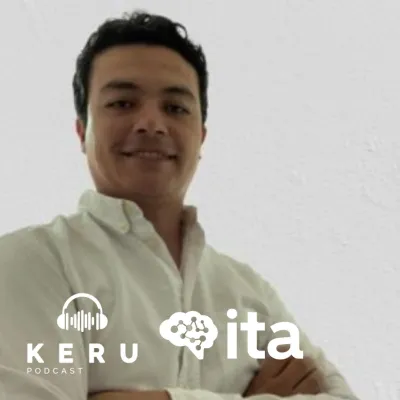

Manuel González Uruguay and intelligent automation in fruit sorting and packing
🔍 Article co-created with Manuel González, General Manager at Sienz , and Augusto Unzaga, host of Keru Podcast.
🎙️ This article was inspired by Episode 16 of Keru Podcast.
Keru Podcast, created by Globalita.io, is a series of conversations (in Spanish) with industrial leaders from Latin America about management, technology and decision-making in complex environments.
When the field reaches the line: new challenges for a complex industry - Sienz Uruguay
The fruit industry has changed radically in the last decade. What used to be a seasonal activity with manual solutions now requires levels of automation comparable to industries such as automotive or chemicals. The international consumer demands consistent quality, full traceability and logistics efficiency. And all of this must be achieved with fruit, one of the most fragile, variable and unpredictable products in the food chain.
Manuel González, from his role at Sienz Latam, knows this complexity in depth. He leads a company specialized in technology solutions for sorting and packing fresh fruit, with operations in Europe, Latin America and the United States.
The challenge: adapting industrial systems to a living raw material that changes every day.
“In this sector you can’t freeze the product, you can’t leave it for tomorrow. You have to process what comes in, with what you have.”
This sentence sums up the essence of the problem: it’s not just about producing faster, but about optimizing under pressure, with variable raw material and ever-tighter margins.
The difficulty of automating without losing sensitivity - technological optimization in fruit
One of the great dilemmas of automation in fruit packing is how to maintain the sensitivity of a human eye without losing the speed of a machine. The human eye can detect subtleties that algorithms don’t always interpret well: a blemish that doesn’t affect quality, a shade that is acceptable depending on the destination market, a small deformation that doesn’t mean rejection.
“There’s a point where human judgment is still irreplaceable. But the system has to learn from it.”
That’s why Sienz doesn’t take a rigid approach to automation. The approach is mixed: algorithms that sort by color, shape and defects, combined with fine adjustments by the operator. The machine proposes, but the human decides. This model recalls the concept of Jidoka from the Toyota Production System, where automation includes the intelligence to stop the process if it detects an anomaly, allowing human intervention.
In addition, the learning curve is shortened through simple interfaces, continuous training and improvements based on direct feedback from operating staff. The system is fine-tuned through use, and that means efficiency depends not only on the equipment manufacturer, but also on the knowledge accumulated in the plant.
Processing without damaging: speed is not enough - automation in fruit packing
In many industries, speeding up the production process is synonymous with improvement. In fruit growing, it isn’t. Increasing speed can mean more physical damage, more discards, more customer complaints. For Manuel González, the goal is not just to process faster, but to optimize the technological process without sacrificing the integrity of the product.
“You can have the fastest line on the market, but if the fruit arrives at its destination in poor condition, all the effort was in vain.”
That’s why every line design includes impact analysis and product flow simulations that take the different varieties into account. Sorting pears is not the same as sorting apples, nor plums the same as kiwis. Technical customization becomes a requirement. And that adaptation also involves modularity: being able to replace components depending on the season or change machine vision parameters without modifying the core architecture.
Traceability as a condition, not a luxury
One of the most important trends in the industry is the level of traceability required by international markets. It’s no longer enough to know the origin of the batch. The customer demands to know where and when each piece of fruit was harvested, at what temperature it was kept, under what conditions it was sorted and what products were applied to it.
In this context, technological optimization is no longer just a competitive advantage, but an obligation in order to operate. In the plants designed by Sienz, every batch of fruit that goes through the line is tracked individually, from receiving to packing. Sensors, cameras and labels make it possible to reconstruct the complete path in the event of a complaint or audit.
Plants designed to survive their own seasonality
One of the most particular challenges of the fruit industry is its extreme seasonality. A plant can be at 100% of its capacity in January and completely stopped in April. This dynamic puts unique pressure on process design and asset use. The key question is: how do you optimize without oversizing?
Manuel González starts from a clear principle: the plant must operate efficiently at its peak, but also remain sustainable in periods of low or no activity. To achieve this, Sienz designs modular and scalable lines.
This type of operational solution is deeply aligned with the principles of Lean Manufacturing: creating value without waste, maximizing the real utilization of assets and designing based on demand, not on aspiration. Flexible standardization —an apparent contradiction— is the key here. Components that repeat, but processes that adjust.
“A fruit line can’t be a fixed block. It has to adapt to the business, to the fruit, to the logistics.”
Technology that learns with the fruit
One of the great advances in recent years is the development of vision and sensors with artificial intelligence capable of sorting fruit by previously unthinkable parameters: sugar content, firmness, color distribution, defects. However, as Manuel González explains, not everything is solved with sensors. The key is for the technology to adapt to the fruit, not the other way around.
“Every variety is different. And every year is different. There’s no algorithm that works the same in every season.”
In response, Sienz has incorporated dynamic calibration systems: algorithms that learn, that adjust through human feedback and that allow reprogramming without retraining from scratch.
But the real value appears when this capability becomes an operational routine. That is, when the technical system and the human team learn together. Technology stops being an isolated tool and becomes part of the operational muscle.
The strategic role of the trained operator
In many industrial processes, the operator performs repetitive tasks without taking part in improvement. In the plants designed by Sienz, the operator is a strategic player. They not only calibrate, but also interpret data, identify anomalies and propose adjustments. This raises the standard of the position and calls for a new professional profile.
To sustain it, Manuel González insists on investing in continuous technical training. It’s not just about teaching how to use the machine, but about developing operational judgment. When should the line be stopped? When should a camera be adjusted? When should a problem be escalated?
This approach is inspired by methodologies such as Jidoka and TWI, which recognize human judgment as a central part of the quality system. If the line stops, it’s not a failure: it’s a sign of maturity. If the operator proposes an improvement, it’s not an isolated gesture: it’s a consequence of organizational design.
In that sense, the operator is no longer replaced by technology, but empowered by it.
Manuel González represents a generation of industrial leaders who integrate technology, operational sensitivity and strategic thinking into every decision. In a historically artisanal sector, his work shows that it is possible to reach levels of excellence comparable to any other advanced industry, without losing the connection with the land or with the fruit.
In a context where logistics pressure, visual quality and traceability have become conditions for entering the market, automation in fresh fruit packing is no longer a future project. It is an immediate need.
Keru Podcast, created by Globalita.io, is a series of conversations (in Spanish) with industrial leaders from Latin America about management, technology and decision-making in complex environments.
Manuel González was General Manager for Latin America at Sienz, leading the company's regional expansion after its spin-off from Compac, a firm of New Zealand origin. With more than 10 years of experience running companies in the agro-industrial and technology sectors in Latin America, he built a career focused on productivity, automation and comprehensive solutions for fresh fruit packing.
View profile and episode →